The National Science Foundation's Predictive Intelligence for Pandemic Prevention (PIPP) initiative and the Center for Pandemic Insight (CPI), in partnership with the CHPS Lab, are building the early warning infrastructure the world needs to get ahead of the next pandemic — before it reaches human populations.
Highly Pathogenic Avian Influenza (HPAI) is no longer a contained wildlife problem. Recent outbreaks have demonstrated sustained transmission from migratory birds to marine mammals, and every cross-species jump brings us closer to a strain capable of spreading between humans. Harbor seals sit at exactly this interface, they are one of our most valuable sentinel species for detecting the early signals of a zoonotic spillover event. The challenge is that meaningful surveillance requires identifying and tracking individual animals across time and space at a scale that manual field methods simply cannot reach.
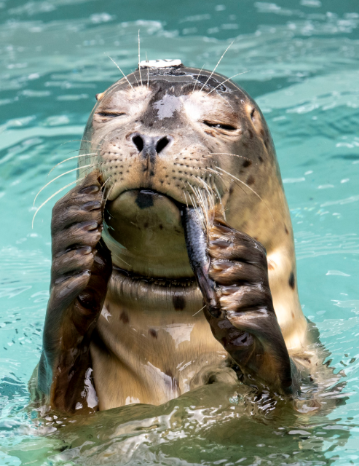
SealID is a computer vision system built to solve that problem. By automating individual seal identification from drone footage and field photographs, it enables non-invasive, continuous, large-scale wildlife surveillance that feeds directly into CPI's pandemic early warning pipeline. Rather than waiting for a die-off to be reported, the system tracks population-level changes in behavior, body condition, and mortality in real time, turning wildlife monitoring from a reactive process into a predictive one.
Leading the computer vision development on this project, the focus has been on a full architectural upgrade of the identification pipeline. The previous system relied on a CNN-based model with manual face chipping, feature annotation, and per-seal retraining, steps that created significant bottlenecks at every stage. The rebuilt system replaces all of that. Face detection and pose-aligned chipping are now handled automatically by YOLOv8-Pose, and identity matching is performed by MegaDescriptor, a Vision Transformer, which encodes each seal face into a 2048-dimensional embedding and matches it against a FAISS vector database of 130+ individually catalogued harbour seals with 300 to 400 reference images per individual. The system achieves 96% face detection accuracy and 73% individual identification accuracy on unseen field data, and extends reliable recognition to side profiles, partial faces, and multi-individual frames that the previous system could not handle. Adding a new individual to the database no longer requires retraining, it requires dropping photos into a folder and running a single script.
A desktop GUI allows researchers to upload any photograph and immediately receive ranked identity matches with confidence scores, making model outputs interpretable and actionable without requiring any technical background. The broader goal is a system robust enough to handle real-world drone footage conditions, varying altitude, angle, lighting, and motion, so that pandemic surveillance can run continuously without human bottlenecks slowing it down. By enabling consistent longitudinal tracking of individual animals, SealID provides the behavioral and mortality data needed to detect anomalies before a spillover event reaches human populations.